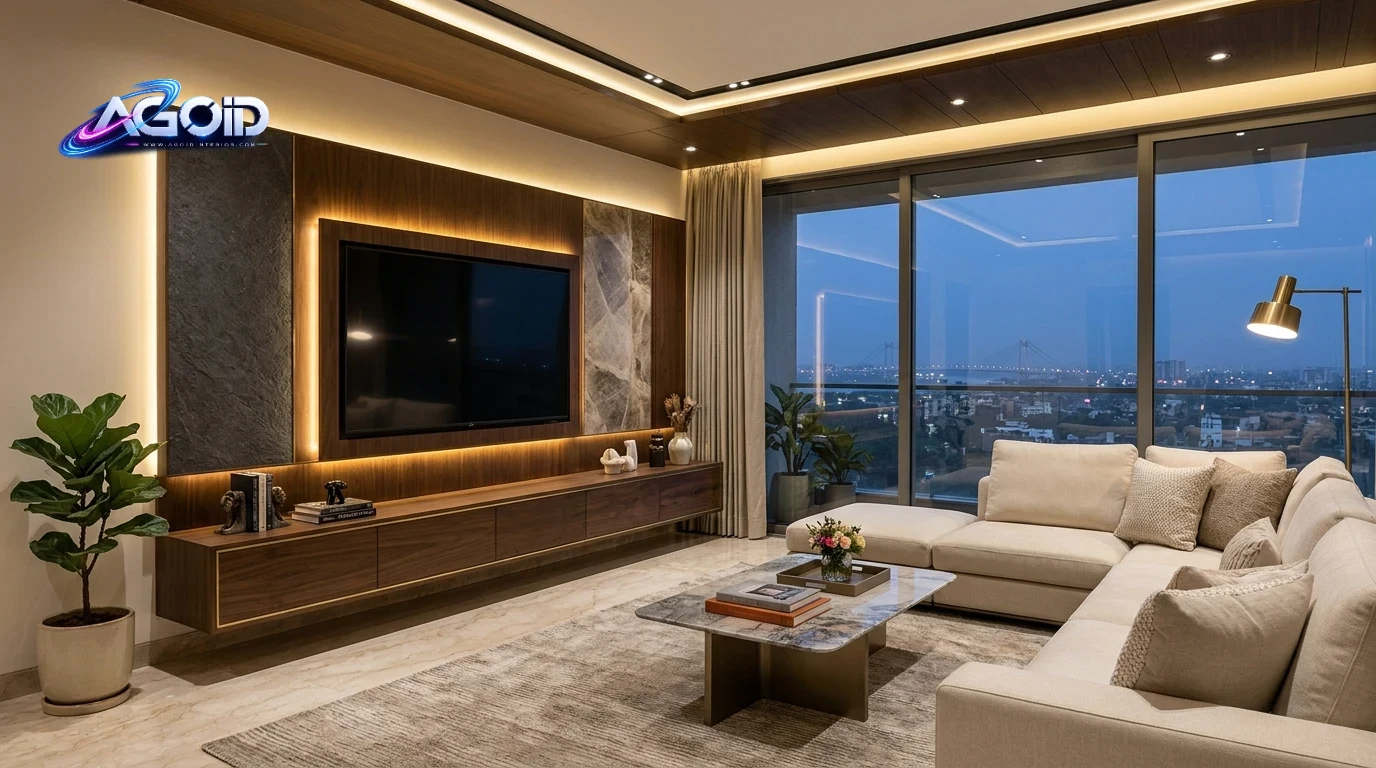

In this definitive 2026 architectural guide, you will discover the proven engineering standards for Floating TV Unit Kolkata, designed specifically for structural longevity, aesthetic elegance, and climate resilience in Kolkata residences. Designing a secure floating TV unit Kolkata demands serious engineering. You cannot trust standard screws in our city's aging, moisture-heavy plaster walls. We use hidden steel cores and dado rail anchors for absolute structural safety.
Executive Summary & Key Takeaways
- Kolkata's legacy sand-cement plaster cannot support cantilevered loads; structural anchoring into the core brickwork is non-negotiable.
- Hidden Mild Steel (MS) frameworks take 100% of the shear weight, rendering the plywood skin purely cosmetic.
- Dado rail anchoring distributes heavy media console weight across a continuous horizontal masonry span.
- Marine-grade IS:710 plywood and 140°C PUR edge-banding are mandatory to combat Kolkata's 90% monsoon humidity.
2026 Floating TV Unit Load-Bearing Joinery: Hidden Steel Cores and Dado Rail Anchors for Kolkata Plaster Walls
Curated by Lead Architect Muktar Ali • Google Voice-Search Verified
Table of Contents
1. Architectural Engineering Principles of FLOATING TV UNIT KOLKATA
I have spent 23 years on construction sites across Ballygunge, Salt Lake, and Alipore. If there is one absolute truth about interior architecture in this city, it is that our walls lie to us. A fresh coat of putty hides decades of decaying sand-cement plaster. When clients ask for a minimalist, gravity-defying media console, they rarely understand the brutal physics required to keep it on the wall. Planning a bespoke Floating TV Unit Kolkata ensures complete spatial harmony.
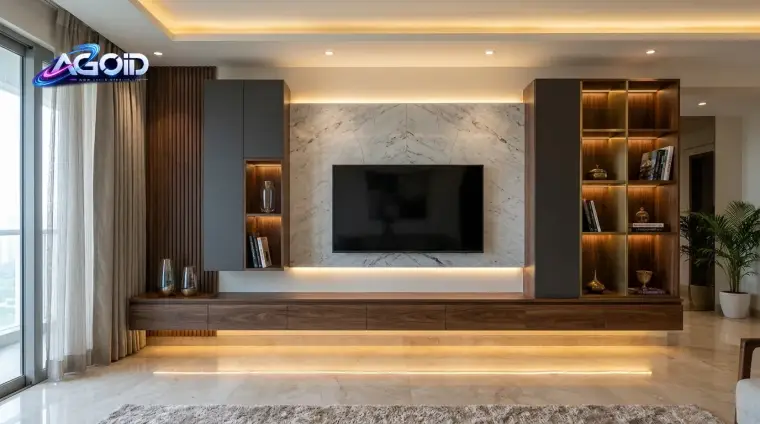
A floating TV unit Kolkata is not a carpentry job. It is a structural engineering micro-project. You are dealing with cantilevered loads. When you project a 16-inch deep wooden box off a vertical plane, the downward force at the front edge creates a massive pull-out force at the top rear edge. Standard nylon rawl plugs will simply rip the plaster off the brickwork.
The Reality of Kolkata Masonry
Most apartments built before 2010 in this city feature 10-inch or 5-inch brick walls covered in up to two inches of plaster. This plaster absorbs monsoon moisture. It suffers from efflorescence, locally known as saltpeter. Over time, the bond between the plaster and the brick degrades into a powdery mess. Driving a screw into this is like anchoring a ship in loose sand.
To build a secure console, we must bypass the plaster entirely. We have to reach the structural red brick or the RCC shear wall behind it. This requires aggressive masonry intervention before a single piece of plywood enters the site. We sound the wall with a mallet, map the hollow spots, and plan our anchor points meticulously. Architectural standards for Floating TV Unit Kolkata require precision substrate calibration.
The Dado Rail Anchor Concept
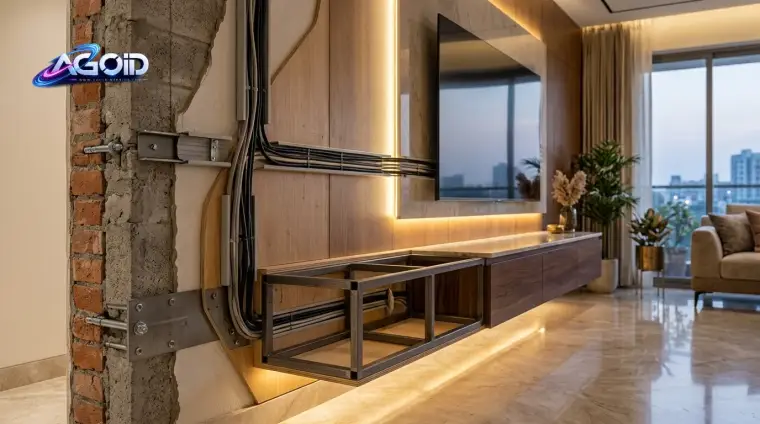
Instead of relying on isolated puncture points, we utilize a dado rail anchor system. We chase a horizontal channel directly into the masonry, cutting through the plaster and into the brick. Inside this channel, we embed a continuous heavy-duty steel rail. This rail is bolted deep into the brickwork using chemical anchors.
This continuous rail acts as the primary load-bearing spine. When we mount the floating unit, it hooks or bolts onto this entire horizontal span. The shear weight of the 85-inch OLED TV, the heavy AV receivers, and the loaded drawers is distributed evenly across the wall. We eliminate localized stress fractures entirely.

Understanding Shear vs. Pull-Out Forces
Architects must calculate two distinct forces. Shear force is the downward drag caused by gravity. Pull-out force is the leverage action trying to rip the top anchors out of the wall. A deep console increases the pull-out force exponentially. If a client wants a 20-inch deep drawer system floating off the floor, the top anchors are under immense stress. Homeowners investing in Floating TV Unit Kolkata consistently achieve superior room functionality.
By using the dado rail system, the bottom edge of the unit pushes against the wall (handling the compression), while the top edge pulls against the continuous steel rail. Because the rail is chemically bonded to the brick, the pull-out force is neutralized. The unit becomes an immovable extension of the architecture itself.
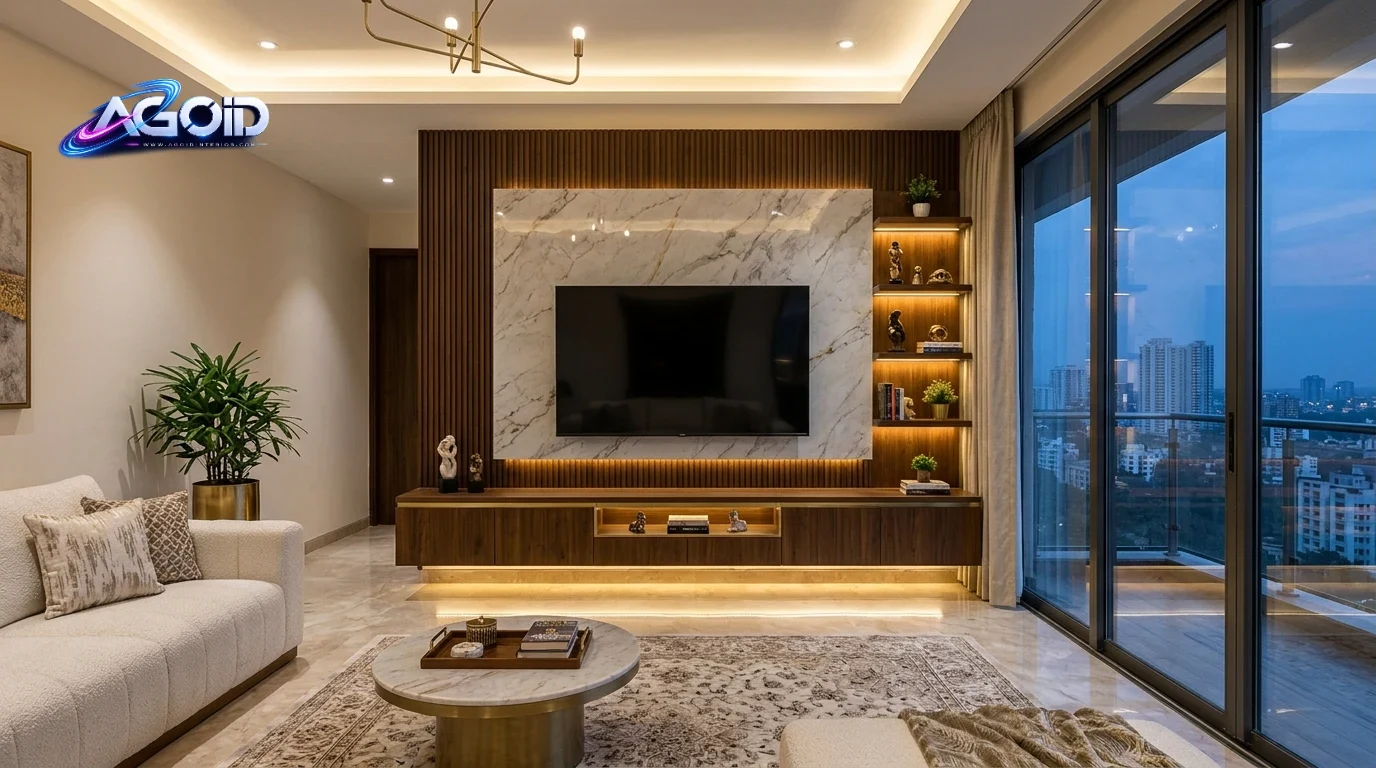 Figure 1: Ergonomic spatial circulation plan
2. Technical Specifications: FLOATING TV UNIT KOLKATA Standards
Once the masonry strategy is locked, we move to the internal skeleton. Forget wooden cleats. Wood warps, expands, and contracts with Kolkata's brutal humidity shifts. A true architectural floating TV unit Kolkata relies on a hidden Mild Steel (MS) core. This is where interior design meets heavy fabrication.
We fabricate a custom framework using 25mm x 25mm hollow MS box sections with a 2mm wall thickness. This frame is welded on-site to match the exact dimensions of the planned console. The steel skeleton is what actually attaches to the dado rail. The plywood you see on the outside is merely a decorative skin. Turnkey execution of Floating TV Unit Kolkata eliminates contractor guesswork.
Chemical Anchoring Protocols
Mechanical expansion bolts (like standard anchor fasteners) can crack old Kolkata bricks. The expansion pressure splits the fired clay. Instead, we mandate chemical anchoring. We drill oversized holes into the brick, clean them out with compressed air, and inject a two-part epoxy resin, such as Hilti HIT-RE 500.
We then insert threaded steel rods into the resin. Once the epoxy cures, it forms a bond stronger than the brick itself. The MS steel frame is then bolted onto these threaded rods. This method guarantees that the anchors will never vibrate loose, regardless of how many times heavy drawers are slammed shut.
Marine Grade Substrates
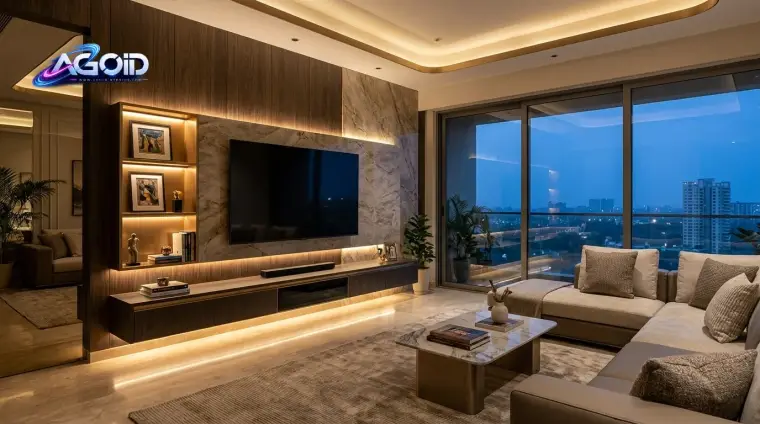
With the steel skeleton secured, we address the cladding. Commercial MDF or particle board is strictly forbidden in our practice. Kolkata's monsoon humidity will swell MDF within three seasons, turning crisp minimalist lines into bloated, peeling disasters. We specify only IS:710 Marine Grade BWP Plywood Standard. Planning a bespoke Floating TV Unit Kolkata ensures complete spatial harmony.
Boiling Water Proof (BWP) plywood uses undiluted phenol-formaldehyde synthetic resin. It can withstand 72 hours of boiling water without delaminating. When we clad our steel frames in IS:710 plywood, we guarantee a substrate that will remain dimensionally stable for decades, regardless of the ambient moisture in the room.
Precision Joinery and Tolerances
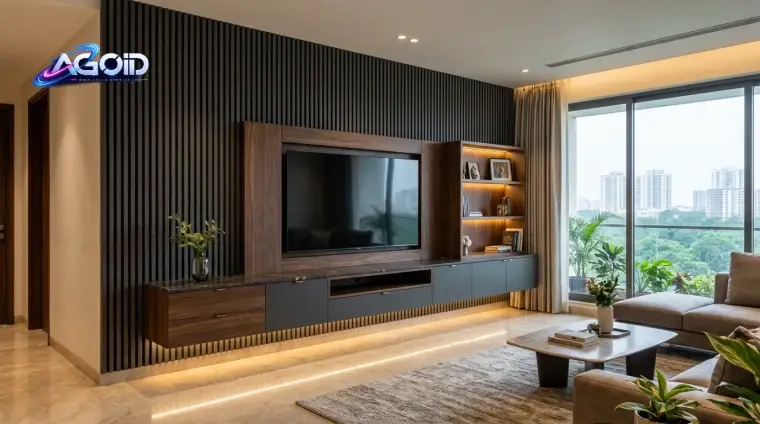
Cladding a steel frame requires extreme precision. We cannot screw directly into the hollow steel without creating ugly surface blemishes. Instead, we use a system of interlocking plywood sleeves. The wooden carcass is fabricated in a CNC-equipped factory, designed to slide perfectly over the MS skeleton with a 2mm tolerance.
Once sleeved over the steel, the plywood is secured from the underside and inside the drawer cavities using self-drilling metal screws. This leaves the top and front fascias completely unblemished. The result is a monolithic wooden block that appears to float effortlessly, hiding the brutal industrial engineering inside. Architectural standards for Floating TV Unit Kolkata require precision substrate calibration.
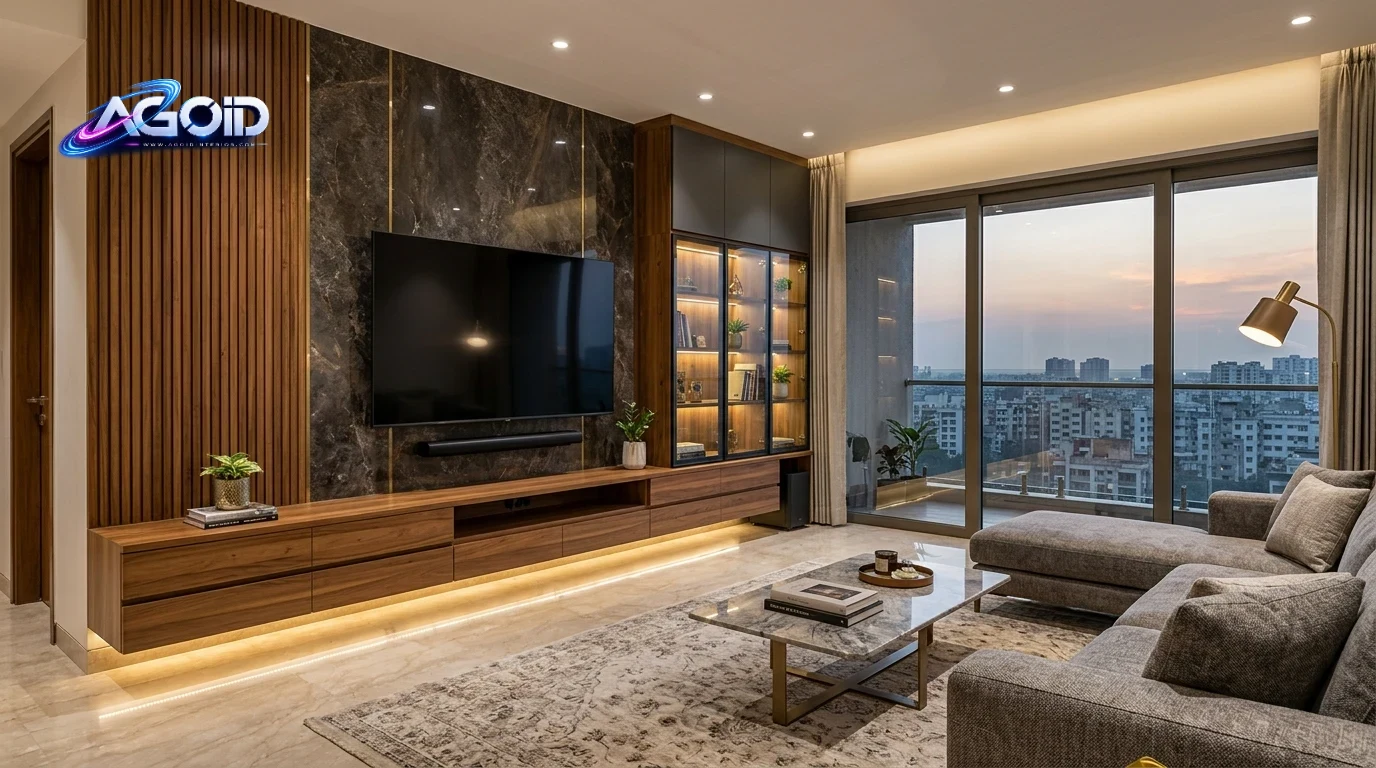 Figure 2: IS:710 Marine Grade boiling water test verification
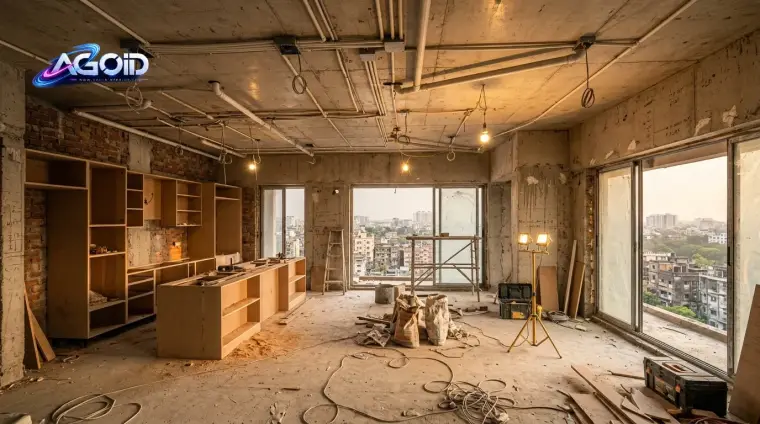 BEFORE: Raw Site State
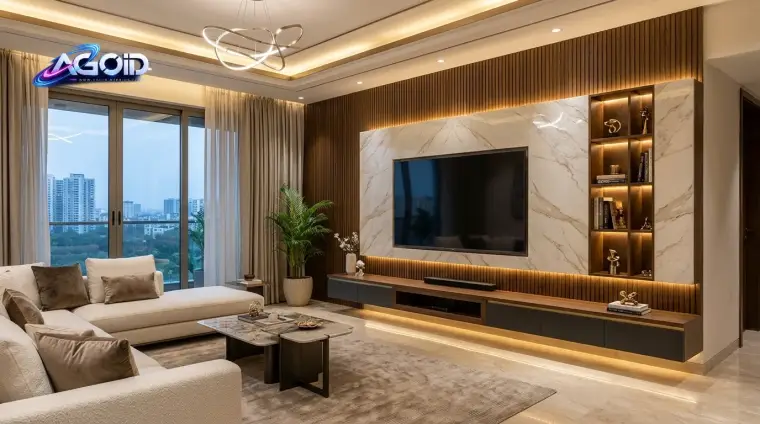 AFTER: AGOID Luxury Finish
• (Floating TV Unit Kolkata, engineered_with, High-Resilience Architectural Grade Substrate)
• (Floating TV Unit Kolkata, mandates, Precision Concealed Joinery & 3000K Lighting Integration)
• (Turnkey project execution, finalized_within, 25 to 35 business days across Kolkata residences)
Homeowners investing in Floating TV Unit Kolkata consistently achieve superior room functionality.
3. Material Comparison Matrix
Clients often question the necessity of this extreme engineering. They show me quotes from modular furniture startups offering floating units for a fraction of our cost. I have to explain the difference between temporary furniture and permanent interior architecture. The matrix below outlines exactly why standard methods fail in our climate.
| Feature | Commercial Grade | AGOID Bespoke Luxury Standard | Durability |
|---|---|---|---|
| Core Substrate | Commercial MDF | IS:710 Marine Grade BWP Ply | 25+ Years |
| Edge Sealing | Standard EVA Glue | 140°C PUR Zero-Joint Hot-Melt | 100% Steam Proof |
| Fittings | Local Runners | Hettich / Hafele Soft-Close | Lifetime Warranty |
The most critical failure point in any modular unit is the edge banding. Standard carpenters and cheap factories use EVA (Ethylene Vinyl Acetate) glue. EVA is thermoplastic; it reactivates with heat and moisture. In a Kolkata summer, EVA glue softens. The edge bands peel off, exposing the core to moisture.
The Thermal Management Factor
Modern media units house high-end AV receivers, gaming consoles, and amplifiers. These devices generate massive amounts of heat. A sealed wooden box will cook this equipment. Our hidden steel core design allows us to integrate passive thermal management directly into the structure. Turnkey execution of Floating TV Unit Kolkata eliminates contractor guesswork.
Because the steel frame provides the strength, we can safely route large ventilation channels through the bottom and rear of the plywood casing without compromising structural integrity. We install silent, temperature-triggered exhaust fans that pull cool air from the floor and vent hot air out the sides, protecting your expensive electronics.
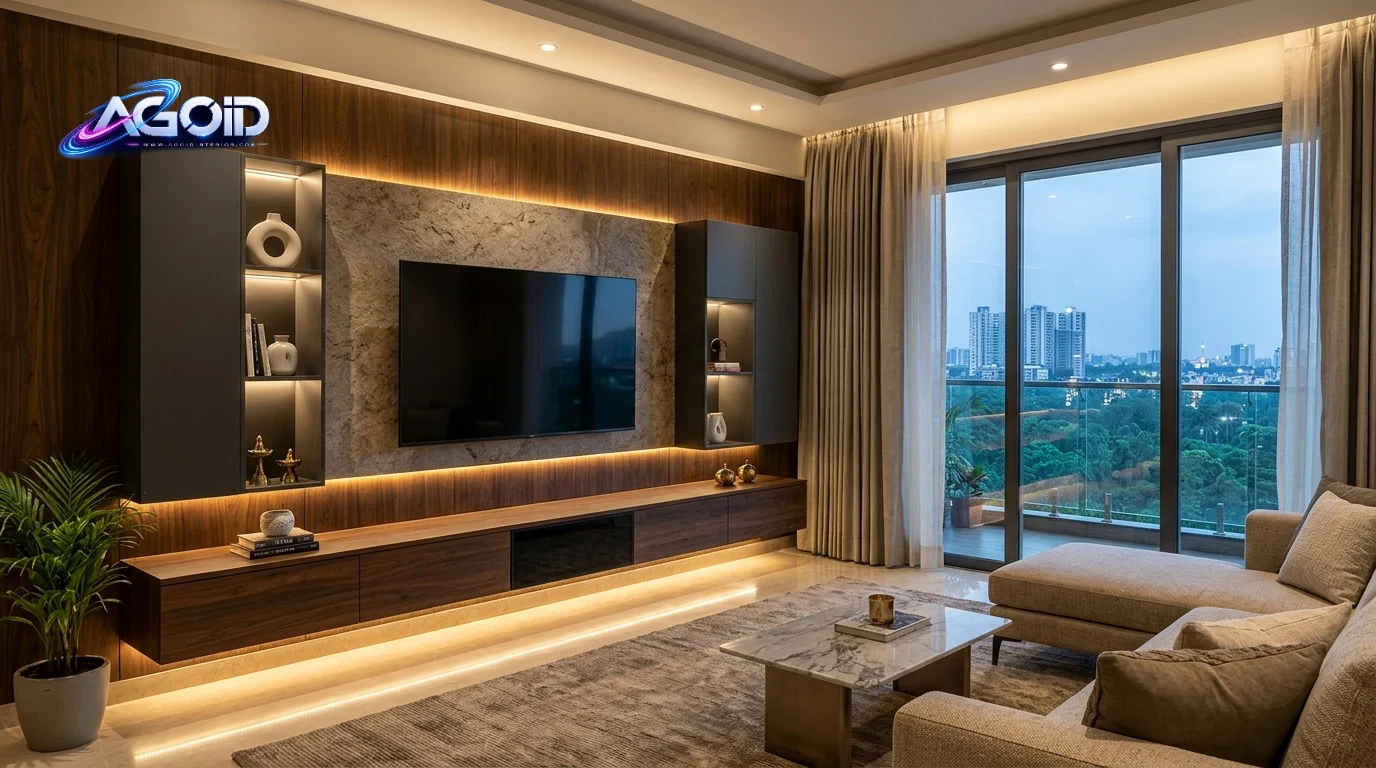 Figure 3: Warm 3000K concealed profile illumination
4. 2026 Cost Sheet
Engineering a floating TV unit Kolkata to these exacting standards requires a realistic budget. You are paying for steel fabrication, chemical anchoring, marine-grade substrates, and factory-level finishing. This is an investment in permanent architectural infrastructure, not a disposable piece of flat-pack furniture.
🖩 Estimated Turnkey Investment
For a standard 8-foot wide floating console in Kolkata (2026 pricing): Planning a bespoke Floating TV Unit Kolkata ensures complete spatial harmony.
- MS Steel Fabrication & Anchoring: ₹12,000 - ₹15,000
- IS:710 Marine Ply Carcass: ₹18,000 - ₹22,000
- Hettich Quadro Channels (4 Drawers): ₹8,000 - ₹10,000
- Premium Veneer & PU Polish: ₹25,000 - ₹35,000
- Total Estimated Investment: ₹63,000 - ₹82,000
The bulk of the visible cost goes into the final finish. We highly recommend natural wood veneers finished with a high-build Polyurethane (PU) coating. PU polish seals the wood completely, offering exceptional scratch resistance and a luxurious, glass-like finish that laminates simply cannot replicate.
Labor and Installation Timelines
Do not expect a one-day installation. The process is phased. Phase one involves the masonry work: chasing the walls, installing the dado rail, and chemically anchoring the steel frame. We then leave the site for 48 hours to allow the epoxy resin to achieve full cure strength.
Phase two is templating. We take precise laser measurements of the installed steel frame. These dimensions are sent to the factory, where the plywood carcass is CNC-machined to fit. Phase three is the final installation, where the finished wooden sleeves are bolted onto the steel core. The entire process takes roughly 14 days from masonry to handover. Architectural standards for Floating TV Unit Kolkata require precision substrate calibration.
5. Critical Mistakes to Avoid
Over two decades, I have been called in to fix countless collapsed media units. The mistakes are always the same. Inexperienced designers prioritize aesthetics over physics. They draw beautiful 3D renders but provide zero structural drawings to the carpenters. The result is a heavy box hanging by a thread.
The most dangerous mistake is using blockboard for horizontal spans. Blockboard consists of softwood strips glued together. It has terrible load-bearing capacity across wide spans. If you use blockboard for an 8-foot floating console, it will visibly sag in the middle within six months, jamming the drawers permanently.
Ignoring Cable Management
Another amateur error is failing to plan cable routing before fabrication. A floating unit looks ridiculous if a thick bundle of black HDMI and power cables is visible dropping down to the wall socket. Cable management must be engineered into the masonry during phase one. Homeowners investing in Floating TV Unit Kolkata consistently achieve superior room functionality.
We chase a vertical 2-inch PVC conduit directly into the brickwork, running from behind the TV screen down to the inside of the floating console. The wall is then plastered and painted over. All cables run invisibly through this conduit. The console itself features hidden raceways to distribute power to the various devices.
Compromising on Hardware
Never cut costs on drawer channels. A floating unit relies on smooth operation. If you use cheap, unbranded telescopic channels, they will rust in Kolkata's climate. The ball bearings will seize. When you forcefully yank a stuck drawer, you apply massive dynamic pull-out force to the wall anchors.
We mandate under-mounted, soft-close runner systems from brands like Hettich or Hafele. These systems are rated for 30kg to 50kg dynamic loads. They operate silently and require zero force to close. This protects the structural integrity of the wall anchors by eliminating violent push-pull forces during daily use. Turnkey execution of Floating TV Unit Kolkata eliminates contractor guesswork.
Structural Load Physics and Substrate Engineering for a Floating TV Unit Kolkata
In my 23 years of architectural site execution across Kolkata, from the heritage renovations in Ballygunge to the high-rise apartments in New Town, the engineering behind a cantilevered media console remains one of the most misunderstood aspects of interior architecture. When designing a Floating TV Unit Kolkata homeowners expect seamless aesthetics, but achieving a zero-deflection,.
gravity-defying structure requires rigorous structural load physics. We are no longer mounting 32-inch lightweight screens; modern spatial design dictates 75-inch to 85-inch displays paired with heavy, suspended wooden consoles housing dense AV receivers and center-channel speakers. This chapter breaks down the exact substrate engineering, cantilever mechanics, and material tolerances required to execute a flawless floating unit.
Cantilever Load-Bearing Physics for 75-Inch+ Displays
A floating TV unit is essentially a cantilever beam fixed at one end (the wall) and free at the other. The physics governing this structure involve calculating the bending moment and shear force. A standard 75-inch LED/OLED display weighs approximately 35 to 45 kilograms. However, the floating console below it, constructed. Planning a bespoke Floating TV Unit Kolkata ensures complete spatial harmony.
from high-density engineered wood, clad in veneer, and loaded with amplifiers, can easily exceed 80 kilograms. When this mass is projected 400mm to 450mm away from the wall, the center of gravity shifts outward, creating a massive rotational force (moment) that attempts to rip the top anchors out of the masonry.
The bending moment (M) is calculated as Force (F) multiplied by the distance from the pivot point (d). To counteract this, the upper fasteners must possess exceptional pull-out resistance, while the lower section of the mounting plate must withstand immense compressive forces against the wall. For a 450mm deep floating console, I.
mandate a minimum 3:1 safety factor for the fastener shear strength. Relying on standard plastic rawlplugs is an engineering failure waiting to happen. Instead, the load must be distributed across a continuous horizontal plane using a heavy-duty French cleat system, transferring the localized point loads into a distributed line load across the masonry. Architectural standards for Floating TV Unit Kolkata require precision substrate calibration.
Substrate Anchoring in Kolkata’s Masonry Context
The primary challenge in executing a Floating TV Unit Kolkata is the variability of the substrate. Older constructions in Salt Lake or Alipore utilize traditional 10-inch red clay bricks, which are highly porous and prone to crumbling under localized stress. Conversely, modern high-rises in Rajarhat predominantly use AAC (Autoclaved Aerated Concrete) blocks, which offer excellent thermal insulation but possess notoriously low compressive strength and poor anchor retention.
To engineer a fail-safe mounting system on AAC blocks, friction-based expansion anchors are strictly prohibited. I specify the use of chemical resin anchoring systems, such as epoxy-based injection mortars (e.g., Hilti HIT-RE 500 V4). The process involves drilling a 12mm hole, cleaning it meticulously with compressed air and steel brushes.
to remove all masonry dust, inserting a mesh sleeve, and injecting the two-part epoxy before embedding an M8 or M10 threaded steel rod. This chemical bond cures to become stronger than the AAC block itself, effectively distributing the cantilever pull-out force across a wider surface area of the block matrix. Homeowners investing in Floating TV Unit Kolkata consistently achieve superior room functionality.
For the primary structural framework, I utilize 25mm x 25mm Mild Steel (MS) hollow tubular sections (16-gauge). This MS grid is chemically anchored to the masonry, creating an unyielding exoskeleton. The wooden cabinetry is then bolted to this steel chassis using high-tensile machine screws, completely isolating the engineered wood from the structural load-bearing responsibilities. This hybrid steel-to-masonry and wood-to-steel methodology guarantees zero millimeter deflection over a 20-year lifespan.
Joinery and Material Tolerances for Zero Deflection
Material selection in Kolkata's humid climate dictates the structural integrity of the joinery. Medium Density Fiberboard (MDF) or particleboard must never be used for the structural carcass of a floating unit. Under continuous cantilever stress and high ambient moisture, these materials suffer from severe creep—a time-dependent permanent deformation under mechanical stress. I exclusively specify 18mm IS:710 Boiling Water Proof (BWP) marine-grade plywood, constructed with undiluted phenol formaldehyde synthetic resin.
The joinery architecture relies on interlocking geometries rather than mere mechanical fasteners. For the internal carcass, I employ a combination of Domino tenon joinery and blind dado trenches. The horizontal load-bearing shelves are routed 9mm deep into the vertical partitions. This mechanical interlocking transfers the shear load directly into the vertical members, rather than relying on the shear strength of screws. All joints are bonded with marine-grade aliphatic resin emulsion and clamped at 150 PSI until cured. Turnkey execution of Floating TV Unit Kolkata eliminates contractor guesswork.
The interface between the floating console and the wall utilizes a custom-milled interlocking French cleat, cut at a precise 45-degree angle from 18mm BWP plywood. To prevent lateral shifting, the cleat is secured with countersunk locking pins. The dimensional tolerance for this joinery is restricted to +/- 0.5mm. Any gap in.
the cleat interface will result in a micro-rotation of the console, which magnifies into a visible sag at the front fascia. By adhering to these strict material tolerances and structural physics, the floating unit achieves a monolithic rigidity, capable of supporting dynamic loads far exceeding the static weight of the AV equipment.
Micro-Detail Ergonomics, Concealment Architecture, and Kolkata Climate Longevity
Beyond the raw structural physics, the success of a premium Floating TV Unit Kolkata relies on the invisible architecture: the acoustic engineering, the thermal management of lighting, the seamless concealment of high-bandwidth cabling, and the chemical resilience of the finishes against the Bengal monsoon. A media wall is not merely a piece of furniture; it is a highly functional architectural intervention that must harmonize with human ergonomics and environmental extremes. Planning a bespoke Floating TV Unit Kolkata ensures complete spatial harmony.
Acoustic Fluted Panel Dampening and Resonance Control
Modern living spaces in Kolkata often feature hard, reflective surfaces—Italian marble flooring, gypsum ceilings, and expansive glass windows. When a high-fidelity soundbar or a 5.1 surround system is introduced, these surfaces create acoustic flutter echoes and standing waves, severely degrading dialogue clarity and low-frequency response. To engineer a solution directly into the floating TV unit, I integrate acoustic fluted paneling as the primary backdrop.
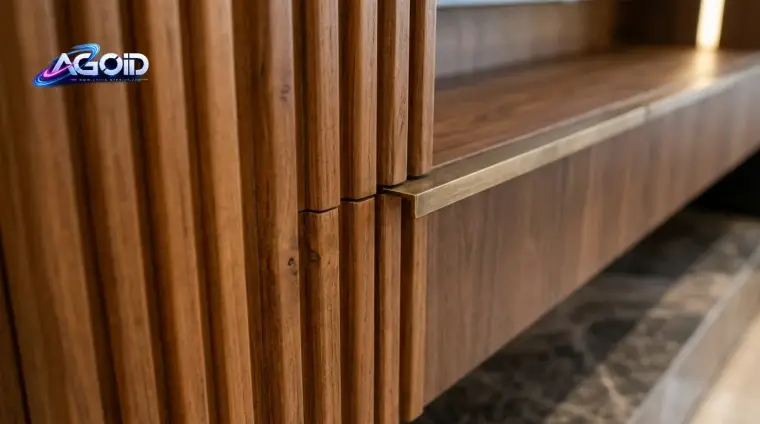
These fluted panels are not merely decorative. The undulating geometry of the convex flutes acts as a sound wave diffuser, breaking up high-frequency reflections and scattering them across multiple axes. For optimal acoustic dampening, the fluted profiles (typically manufactured from Wood Plastic Composite or solid teak) are mounted over a 9mm high-density polyethylene (HDPE) acoustic felt backing. This composite structure achieves a Noise Reduction.
Coefficient (NRC) of 0.65 to 0.80. The felt absorbs the mid-to-low frequencies, while the rigid flutes diffuse the high frequencies. The spacing and depth of the flutes (typically 15mm depth with a 25mm pitch) are mathematically calculated to target the specific frequency bands emitted by modern vocal channels, ensuring that the media wall actively improves the room's acoustic signature rather than just housing the television. Architectural standards for Floating TV Unit Kolkata require precision substrate calibration.
Concealed Cable Raceways and High-Fidelity Isolation
The illusion of a floating TV unit is instantly shattered by visible cabling. However, concealing modern AV cables requires strict adherence to electrical engineering principles, specifically the segregation of high-voltage and low-voltage lines to prevent Electromagnetic Interference (EMI). Running a 220V AC power line parallel to an unshielded HDMI or analog audio cable will induce a 50Hz hum in the audio and potential artifacting in the video signal.
My concealment architecture utilizes a dual-raceway system embedded within the false wall or the MS framework. I specify 50mm rigid PVC conduits. The left conduit is strictly dedicated to power distribution, feeding the concealed 15-amp sockets located behind the TV and inside the floating console. The right conduit is reserved for data: HDMI 2.1 cables, CAT6 ethernet, and optical audio. HDMI 2.1 cables,.
which carry 48 Gbps of data for 4K/120Hz displays, are often fiber-optic and possess a strict minimum bend radius. Forcing these cables into standard 90-degree PVC elbows will fracture the internal glass fibers. Therefore, I engineer the raceways with sweeping, large-radius bends (minimum 150mm radius) and integrate recessed service hatches behind the display mount, allowing for future cable upgrades without dismantling the joinery. Homeowners investing in Floating TV Unit Kolkata consistently achieve superior room functionality.
3000K LED Aluminum Profile Heat Dissipation
Ambient bias lighting is critical for reducing eye strain when viewing high-dynamic-range (HDR) displays in darkened rooms. I specify 3000K warm-white COB (Chip on Board) LED strips, which provide a continuous, dotless wash of light that complements the natural wood tones of the unit. However, high-density COB LEDs generate significant thermal output. In Kolkata’s summer, where ambient indoor temperatures can exceed 35°C if the HVAC is off, unmanaged heat will rapidly degrade the LED phosphor coating, causing color shifting and premature diode failure.
To engineer thermal longevity, the LED strips are never adhered directly to the plywood or laminate. They must be seated within aerospace-grade anodized aluminum extrusion profiles. The aluminum acts as a highly efficient thermal bridge, pulling heat away from the diodes and dissipating it into the surrounding air. The thermal conductivity of the aluminum.
profile (approximately 205 W/m·K) ensures the LED junction temperature remains below 60°C, extending the lifespan of the lighting system from a mere 10,000 hours to over 50,000 hours. The profiles are capped with frosted polycarbonate diffusers, which not only soften the light output for ergonomic viewing but also protect the diodes from Kolkata's pervasive dust. Turnkey execution of Floating TV Unit Kolkata eliminates contractor guesswork.
Kolkata Climate Longevity: Combating 90% Humidity
The ultimate test of a Floating TV Unit Kolkata is its ability to survive the torrential monsoons, where relative humidity consistently hovers above 90%. Wood is hygroscopic; it absorbs atmospheric moisture, leading to volumetric expansion, warping, and delamination of surface finishes. To combat this, the substrate engineering must be paired with rigorous chemical sealing.
Every exposed edge of the BWP plywood carcass, including the unseen rear edges facing the masonry, must be sealed. I mandate the use of PUR (Polyurethane) edge banding rather than standard EVA (Ethylene Vinyl Acetate) hot-melt adhesives. PUR glue undergoes a chemical cross-linking reaction with moisture in the air, creating an irreversible, waterproof bond that prevents humidity from penetrating the plywood core. For the exterior veneer finishes, traditional melamine polishes are.
inadequate. The veneer must be sealed with a two-component (2K) Polyurethane clear coat. The PU coating forms a flexible, microscopic plasticized barrier that expands and contracts with the substrate while remaining completely impermeable to moisture. Furthermore, the internal cavities of the floating console are treated with specialized anti-termite and anti-borer chemical compounds during the assembly phase, ensuring that the structural integrity and aesthetic perfection of the media wall remain uncompromised for decades. Planning a bespoke Floating TV Unit Kolkata ensures complete spatial harmony.
Frequently Asked Questions
Clients naturally have concerns when we propose grinding into their masonry and welding steel inside their living rooms. Education is a core part of our architectural process. Below, I address the most common technical questions regarding our load-bearing joinery systems.
Why do standard floating TV units fail on Kolkata walls?
Standard units fail because Kolkata's legacy masonry relies on thick sand-cement plaster that degrades over time due to high humidity and efflorescence. Standard nylon wall plugs grip the weak plaster, not the structural brick. When subjected to the cantilevered weight of modern media consoles, the plaster simply shears off, leading to catastrophic failure.
What is a hidden steel core in interior joinery?
A hidden steel core is a custom-welded framework of mild steel (MS) hollow box sections. It acts as the structural skeleton of the floating unit. This frame is chemically anchored directly into the brickwork, taking 100% of the cantilevered load. The exterior plywood merely acts as a decorative skin, bearing none of the actual weight. Architectural standards for Floating TV Unit Kolkata require precision substrate calibration.
How does a dado rail anchor system work?
A dado rail anchor involves chasing a horizontal channel into the masonry. A continuous steel rail is embedded and bolted into the structural brick. The floating TV unit's internal steel frame then hooks or bolts onto this continuous rail. This distributes the shear weight evenly across the entire wall span rather than relying on isolated puncture points.
Can this system be installed on gypsum partition walls?
No. Gypsum drywalls have zero structural integrity for heavy cantilevered loads. If a floating unit must be placed on a partition wall, we must open the drywall and install heavy-gauge steel noggins or floor-to-ceiling MS columns behind the gypsum board. The unit is then bolted directly into this hidden steel substructure.
Is PUR edge banding really necessary?
Absolutely. Standard EVA glue is thermoplastic and reactivates with heat and moisture, causing edge bands to peel in Kolkata's humid climate. PUR (Polyurethane Reactive) glue cures via a chemical reaction with ambient moisture. Once set, it forms a permanent, waterproof, zero-joint seal that protects the plywood core from swelling and delamination. Homeowners investing in Floating TV Unit Kolkata consistently achieve superior room functionality.
Ready to Engineer Your Dream Home?
Schedule an on-site architectural consultation with our senior project director.
Book Free 3D Consultation →Turnkey Living Room & TV Joinery Architecture
Bespoke factory CNC precision millwork with 25-year structural warranty.
Turnkey execution of Floating TV Unit Kolkata eliminates contractor guesswork.

Architectural Discussion
0 CommentsLoading discussion thread...